
When Spirituality Becomes Too Sweet

laura-ockel-zAOBpEE_vV4-unsplash

Every Sunday, I religiously watch Meet the Press. It has become sort of like my church. Unfortunately, right after that is Joel Osteen. (Insert eye roll here) Everyone knows this guy — he’s that positive preaching guru, whose snake oil salesmen smile stretches almost as wide as the TV screen. He’s sold millions of books on the bogus idea that believing hard enough and wishing long enough, will bring you blessing upon blessing. Sermon after sermon, he preaches on how God is in control if we just keep trusting. Well, that sounds nice and pretty innocuous, right? I guess. But what about the mother who prayed, believed and hoped but has to face the reality of burying her child because the cancer was stronger than her prayers? Or the family who lost their home despite their fervent praying, hoping and wishing? Then those positive and innocuous messages actually become hurtful and cruel.

Recently, I was listening to a friend’s podcast, (www.whatifproject.net) where he interviewed author Thomas Jay Oord. Oord’s latest book is called God Can’t. He argues in his book that because God is Love, there are many things God can’t do. God can’t take a gun out of someone’s hand. God can’t always cure disease because God cannot override bacteria, cancer cells and the like because these organisms have free will — God defers to modern medicine and people to get most of His work done. There are some things I agree with in Oord’s book, but I would have to say I disagree with the majority of it, even though I am not a theologian.

The larger point, though, is this…

We often hear about how eating too much sugar and artificially flavored foods is unhealthy. But some brands of spirituality are just as sweet and sugary as a box of Fruity Pebbles, yet are consumed in an abundance. Is Joel Osteen really helping anyone in the long run?  Is his spirituality healthy for our souls? Our minds? Our lives? Even if it gives us a temporary sugar high and makes us feel good for the moment, inevitably it will wear off as all highs do, and we will be left with the questions about if what we are consuming is actually doing us any good.

Can we consider the following?

Maybe we need to embrace the fact that our prayers can connect us with Love in its highest form, and with each other — and that can be healing in ways we never gave thought to.

Prayer doesn’t always cure the disease. We need only look around and see the many people suffering who have prayed for over a decade and still are without relief. Maybe God is in the support of the people around us, or in the medicine we take, or the doctors we see.

Maybe prayer doesn’t “work.” Praying for a specific outcome is great, but prayer doesn’t guarantee this outcome. And if you get your desired outcome, it doesn’t mean your prayer worked any more than not getting it means your prayer didn’t work. “Everything is grace,” said St. Therese of Lisieux. Prayer can open our minds to new ideas and guidance that helps us in our treatment. Prayer can give us the strength to carry on or the peace we need to rest.

God is not always in control. You need only look around and see the major cities that have been leveled by Tsunamis and earthquakes. God couldn’t stop those things from happening, but maybe God is in the rebuilding – the making of something new.

God can’t swoop down from the heavens and take the gun out of the shooters hand. You need only look at the media coverage of the horror stories of senseless killing of innocent children. God is in the weeping and mourning with us and God is in the tireless efforts of people who stand up and work toward stricter gun control laws.

Finally, there may not be some grand plan for your life as Osteen and others like him seem to repeatedly suggest. However, your life has immense value and worth. You were created with talents, abilities and ways of being in this world that are unique to you. When you put those to use, even in the smallest of ways, the world is better off for it and forever changed. You are not a puppet on string being dragged along by some divine taskmaster. Your life was given to you and you get to decide what you do with it. There is no one path you must take to get it right. When confused, God will help you, empower you and inspire you but will never coerce you or force you.

So, while I disagree with some of Oord’s theology…I’d have to agree with him that there is a brand of spirituality out there that hasn’t gotten us very far or done much good for our souls.  I think we need to wean people off the sticky-sweet theology of a Higher Power who comes along like a genie in a bottle to fix everything to our liking if we just stay positive and full of faith. Clearly this deity does not exist and faith is not what these people are full of.

Of course, there are miracles. This is a universe where not everything can be understood or explained…just yet. We are dealing with immense mystery. Embracing that mystery is hard and messy and confusing…but God is in that, too.


Photo by Laura Ockel on Unsplash
 

I’m Sorry: An Open Letter to The Chronically Ill and Disabled

1564195039666871343226 (1)

People say a lot of things. Some human beings have the capacity to talk forever, it seems. They complain, they rant, they get mad, they explain themselves. They go on and on, but very rarely do you ever hear the words that most need to be said…and heard. “I’m sorry.”

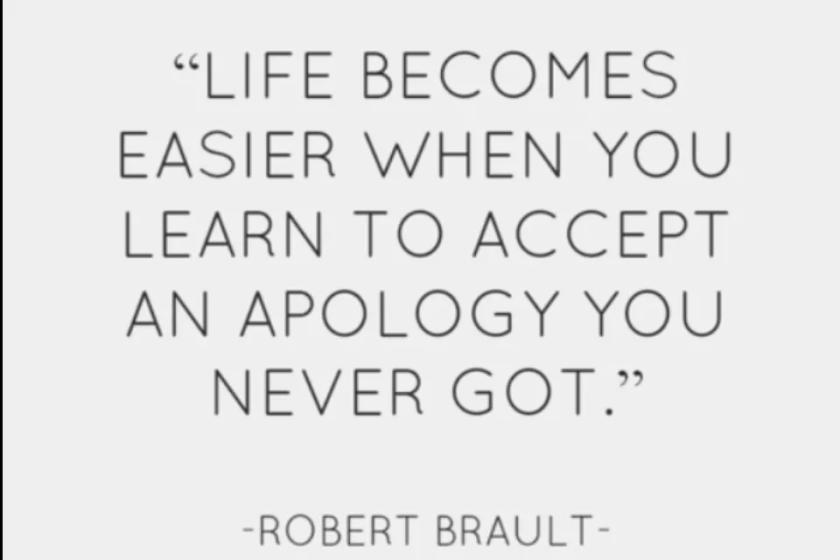
I came across a quote that suggested that accepting that we will never get an apology, a sincere apology I assume, life will somehow become easier. When we accept the apology we never got, life becomes easier? I don’t know how true that is because they also say, “Better late than never.” But sometimes it is too late. Too late to save the marriage, too late to cure the disease, too late to repair a broken relationship, too late to see that dream come true. This isn’t meant to be discouraging. No, it’s just one of the realities of life. But I think it’s healing to hear that someone is sorry for what you are going through, especially when that person knows what it is to go through what you are going through.

So, here it is…

I’m sorry for all the ways society stigmatizes you and puts you in a box that you don’t fit in. I’m sorry that you get treated so shitty by doctors and medical professionals that are supposed to be caring for you and helping you. I’m sorry your family misunderstands you or has abandoned you when you needed them most. I’m sorry you are not always taken seriously. I’m sorry for all the harsh remarks and unkind words you receive on a weekly basis. I’m sorry that you often feel invisible and left out. I’m sorry that you grieve over what you have lost, of things that can never be and things that never were. I’m sorry that people label you as “negative” when in reality you are fighting for your life and sometimes it gets too much to bear. I’m sorry that people forget your birthday when they seem to remember everything else rather easily. I’m sorry that your life did not turn out as planned. I’m sorry that it often feels that everyone has forgotten about you because people are too busy dealing with their pain to notice yours. I’m sorry that so many people place so many expectations on you. I’m sorry that you place so many expectations on yourself. I’m sorry that all of your extra money goes to prescription costs, doctor visits and medical tests. But most of all, I’m sorry that I had to write this because it shouldn’t have come from me, but from that person or those people that you needed most to hear it from. And I’m sorry that even if you got that apology, it would be too little, too late.

And for everything else…I’m sorry.


Guest Post — Sr. Melannie Svoboda

sam-manns-399879-unsplashLearn a Lesson from Fido

by MELANNIE SVOBODA SND

Sometimes I envy dogs. I’m speaking of dogs with good homes, mind you. Such dogs have it made. They are fed, petted, walked, and played with every single day—and they do virtually nothing to deserve it. Oh sure, they provide companionship, they guard the house when we’re gone, they fetch the paper, or they bark when a stranger comes to the door. But other than that, most dogs don’t do an ounce of real work—unless they fall into the category of “working dogs,” like sheep herders, drug sniffers, sled pullers, therapy dogs, etc.

The primary reason I envy dogs is because they are exceptionally wise. In his book, How to Argue and Win Every Time, Gerry Spencer puts it this way: “The wisdom of my dog is the product of his inability to conceal his wants.” How true that is!

When dogs want to go outside, for example, they’ll stand by the door and keep fussing until someone lets them out. When dogs aren’t feeling well, they don’t conceal this fact. Instead, they droop their head and go lie down in the corner or under a table. When dogs need affection, they tell you by plopping their heads on your lap and looking at you with those pleading eyes until you give in and pet them. If only we humans were a little more like Fido. If only we were better at revealing our wants.

Children are pretty good at revealing their wants. I was in a grocery store checkout line once. Behind me was a young mother and her small son. As soon as he saw the candy display, his eyes got real big and, pointing to one of the candy bars, he announced, “I want that, Mommy.” He had clearly expressed his want. His mother tried to distract him, but he was persistent. Finally, she said, “You can’t have that. It costs money.” To which the little boy replied, “Use your credit card!” I thought, “How quickly they learn!”

If we don’t reveal our wants appropriately to others, then they have to try to guess what we want. And they might

guess wrong. When this happens, we end up with dialogues such as these:

“But I thought you wanted to go away for the weekend.” “No, I would have preferred a quiet weekend at home.”

“Why do we have to go to that restaurant again?” “But I thought you liked that restaurant.”

“How come we never have fish for supper?” “I thought you didn’t like fish.”

There is a real danger in concealing our wants from others: we run the risk of concealing our wants even from ourselves. Several years ago I was in a bad space. I had too much work to do, I was discouraged, and I was exhausted. I went to see a counselor. She was great. In the midst of our conversations, she asked, “If you had two days completely to yourself, what would you want to do?” I had to think for a bit because I hadn’t thought about MY wants in a long time. I was too busy trying to meet the wants of others.

But I finally said, “Sleep.” She said, “Okay. The first day you sleep as much as you want. You can stay in your pj’s all day if you choose. Now, what do you want to do on the second day?” Slowly, I began to name some things… I’d like to see a good movie… I’d like to read a novel… I’d like to go out to dinner with a friend or two… I’d like to visit the wild animal rescue shelter in the park…” And the list went on. The counselor had gotten me back in touch with my own wants. In future sessions, we figured out how I could work some of my wants into my regular schedule.

There’s another reason why it’s important to stay in touch with our wants. It can make us more sensitive to the needs and wants of others. In addition, It’s one way we get in touch with God, for our deepest wants and desires are put into us by God. If we follow them, they will lead us ultimately to God.

How do you stay in touch with your personal needs and wants?

How do you share these with others?

How sensitive are you to the needs and wants of others?

Has there ever been a dog in your life that imparted wisdom to you?

If we follow our deepest wants, needs, and desires we will ultimately find God.


You can sign up to receive weekly reflections by Sr. Melannie here.

The Ambiguity of Spiritual Discernment

aleksandra-boguslawska-509-unsplash

“In approaching the Spirit’s movements … [we are called to] a habitual leaning into our souls in God, with a quality of trust in the abyss of divine love there, wanting to see our desires transformed in the light of God’s desire for us. We rest attentively in that abyss ultimately without knowing anything except our desires to embody those qualities of soul in our lives. …

Often we are not given … clear sight and [must] rest in our trust that we will be given enough of what we need to see as we go along. … Sometimes decisions need to be made without clear sight, but with just enough light to take a first step in one direction or another, trusting that the Spirit will shape our path with us as we go along. …

[The discernment process] may well not provide clear specific discernment, but over time … it can provide a way of approaching decisions that frees us from a focus on “getting it right,” that is, finding out just what God wants, or else we will be lost. Instead, we become free for a focus on an ongoing divine/human dance together … one that keeps us living out of our deep souls no matter how vague our sense of what decision to make. …

When we live out of our souls in trust, we become looser about knowing, and willing for a blind walk when that is what is given.”

[From pp. 64-65 in Spiritual Director, Spiritual Companion. Copyright © 2001 by Tilden Edwards.]

An apple a day doesn’t keep the doctor away?

benjamin-wong-485320-unsplashEvery doctor and nutritionist and health guru will tell you to eat more fruits and veggies – preferably organic and non-gmo. While I am all for this type of diet, it’s not always helpful for people with mast cell activation syndrome (MCAS).
MCAS is where your body inappropriately releases histamine and other inflammatory substances causing allergic-type reactions. These reactions can be serious, even deadly.  Even worse, for many of us with mast cell disorders, food is a big trigger. Certain fruits, vegetables and meats can be very high in histamines, making them off limits. Also, fragrances, extreme temperatures, medications, stress and on and on and on. All of these can be triggers. Most of us are on restricted diets. I can only eat 2 or 3 fruits and maybe 4 vegetables at most. So it’s very frustrating to have to keep explaining to the medical community, nutritionists and natropaths why you can’t follow their “miracle” diets that are supposed to make you better.

I was talking to a “healer” recently and he told me that he put his father on this special diet and his arthritis improved significantly.  Do I believe him? Absolutely. There is a lot to be said for the kinds of stuff we put in our bodies and our health. It seemed, though, that it was hard for this man to understand that I cannot just eat a big, fresh, organic salad every single day. I cannot drink green shakes, take supplements or juice my way to health since one grape can land me in the emergency room. It’s a very hard disease to understand, as the nuances are many to say the least. This is why we need more education and advocacy.

There are varying degrees of limitations with MCAS. Some people take meds that help them a lot and they watch their diet carefully to avoid triggers and they have a decent quality of life.  Some are so bad that they need to be on a feeding tube. The rest of us fall somewhere in the middle. We are hyper-sensitive to foods, environment, scents, soaps and temperatures. There are only a limited number of foods we can eat — some of them may be healthy, some of them not. We pop antihistamines all day long, carry an epipen and obsess over food labels. We live hyper-vigilant lives.

So, while I fully support eating healthy, unfortunately it isn’t always going to help us “masties” to get well.  We all know that saying, “An apple a day keeps the doctor away.” Well, for me, it’s “an apple a day gets me a trip to the ER.”

Some quotes for your journey…

camille-orgel-551599-unsplashI have always enjoyed reading the thoughts of others. I love those little books of quotes they sell at bookstores. I guess you can say I collect them. I’ll open them now and then just for fun. Maybe to feel a little better or a little bit wiser. Here are some of my favorites. What are some of yours?

“Do not wish to be anything but what you are, and try to be that perfectly.” – St. Francis de Sales

“Here’s to the crazy ones. The misfits. The rebels. The troublemakers. The round pegs in the square holes. The ones who see things differently. They’re not fond of rules. And they have no respect for the status quo. You can quote them, disagree with them, glorify or vilify them. About the only thing you can’t do is ignore them. Because they change things. They push the human race forward. And while some may see them as the crazy ones, we see genius. Because the people who are crazy enough to think they can change the world, are the ones who do.”― Rob Siltanen

“You think you know someone by looking at their appearance, body language and gestures. You assume when someone is smiling and laughing that they are happy and carefree in their life. But what if that’s not always the case? What about those who smile and are actually hiding a multitude of emotions, pains and struggles in their life? Every person you meet is going through their own battles and we should all be more quick to show compassion and kindness toward one another, rather than judge and make assumptions based off of what we see.” –Kelly Fricke

“I always wanted a happy ending … Now I’ve learned, the hard way, that some poems don’t rhyme, and some stories don’t have a clear beginning, middle, and end. Life is about not knowing, having to change, taking the moment and making the best of it without knowing what’s going to happen next. Delicious ambiguity.” –Gilda Radner

“Truly, it is in the darkness that one finds the light, so when we are in sorrow, then this light is nearest of all to us.” –Meister Eckhart

“Ask, and it will be given you;
seek, and you will find;
knock, and it will be opened to you.” –Luke 11:9

“You must do the thing you think you cannot do.” –Eleanor Roosevelt

“Have patience with everything unresolved in your heart and to try to love the questions themselves. Don’t search for the answers, which could not be given to you now, because you would not be able to live them. And the point is to live everything. Live the questions now. Perhaps then, someday far in the future, you will gradually, without even noticing it, live your way into the answer.” –Rainer Maria Rilke

“What the caterpillar calls the end of the world, the master calls a butterfly.” –Richard Bach

“Some mystics taught that the human soul comes from God and that the last thing that God does before putting a soul into the body is to kiss the soul. The soul then goes through life always dimly remembering that kiss, a kiss of perfect love, and the soul measures all of life’s loves and kisses against that primordial perfect kiss.” –Ron Rolheiser

“It may be that some little root of the sacred tree still lives. Nourish it then, that it may leaf and bloom and fill with singing birds.” –Black Elk

“Give. But don’t allow yourself to be used. Love. But don’t allow your heart to be abused. Trust. But don’t be naive. Listen. But don’t lose your own voice.” –Unknown

“You do not need to know precisely what is happening, or exactly where it is all going. What you need is to recognize the possibilities and challenges offered by the present moment, and to embrace them with courage, faith and hope.”- Thomas Merton

“A tree gives glory to God by being a tree. For in being what God means it to be it is obeying Him. It “consents,” so to speak, to His creative love. It is expressing an idea which is in God and which is not distinct from the essence of God, and therefore a tree imitates God by being a tree. The more a tree is like itself, the more it is like Him. If it tried to be like something else which it was never intended to be, it would be less like God and therefore it would give Him less glory. No two created beings are exactly alike. And their individuality is no imperfection. Therefore each particular being, in its individuality, its concrete nature and entity, with all its own characteristics and its private qualities and its own inviolable identity, gives glory to God by being precisely what He wants it to be here and now, in the circumstances ordained for it by His Love and His infinite Art.” — Thomas Merton, New Seeds of Contemplation

“Courage does not always roar. Sometimes courage is the quiet voice at the end of the day saying, ‘I will try again tomorrow.” — Mary Anne Radmacher

“Ring the bells that still can ring. Forget your perfect offering. There is a crack, a crack in everything. That’s how the light gets in.” – Leonard Cohen, Anthem

“Do not oppress one another.” – Leviticus 25:17

5 Reasons Why I Find Facebook Support Groups (Mostly) Unhelpful

rawpixel-552393-unsplashAnyone suffering from a chronic illness knows the importance of having lots of resources at your disposal. If you’re anything like me, Google is your best friend and sometimes this leads you to online support groups. They can be a great resource, especially for people who cannot leave their home.
Facebook offers a wide range of support communities. Sometimes they help people feel less alone, which is great. Throughout the years, I have been a participant and an admin. of many support groups on Facebook. I’ve noticed that these groups tend to trigger more anxiety and frustration in me rather than helping me. Having that said, I have also met some really great people through social media and have found some fantastic resources that have helped me to cope and have educated me.

First, I want to say that nobody is perfect. There is no perfect group, church, friend, ect. So, to expect perfection all the time is not realistic or healthy. However, there are things that make Facebook communities more damaging than helpful.

I’ve noticed these 5 recurring issues…

Poor Admins: Many times, groups are run by people with little to no experience. Sometimes, the admins have experience with a specific disorder like depression, anxiety, lupus or mast cell activation disorder. While experience with an illness is great, you need to have people skills in order to resolve conflicts in an appropriate way. Rules for the group need to be established and enforced, because rules and guidelines maintain a sense of order. However, excessive rule-making and trying to micromanage people’s every word and post is highly ineffective. Someone is going to be offended by something. Some people are always offended. Admins have to be adults and let others be adults, too. In an ideal world, this would always happen.

In certain situations, the admins are affiliated with an organization or doctor. This MAY make the support group more toxic than helpful because they may be receiving funds from the organization or doctor or giving funds and grants to a doctor for research. This means the admins will be loyal to the organization or doctor before the patients and members of the group. Be cautious of these groups and never give anyone money without doing proper research.

Miscommunication: You can only interpret so much online. You cannot see body language or hear tone of voice. This leads to a lot of misunderstandings and fighting, which leads to more people fighting and then an admin having to shut down the conversation and then everyone is pissed off because someone posted a funny meme, or asked a question and one person decided to attack…now we have drama. It’s very unhelpful for people who are already stressed out and sick.

Good intentions: A lot of people have good intentions. But remember that saying about good intentions? It’s true. Someone means well, but in the end they say or do things that minimize someone’s struggle. They have the perfect advice for you. If you’d just do this yoga, read this book, take these supplements and meditate, you can be healed. Really? If that were true, would any of us be here in this group?

The trolls: Yes, there are many trolls in support groups. You would think that everyone in these support groups were there to offer support and encouragement and receive support and encouragement. The sad truth is that some people enjoy hurting other people, even those who are sick and struggling.

Lack of empathy: Some people do not know how to show empathy. They are sick and they are angry and they want to take it out on you. Or sometimes they have had to go through really difficult things alone and so they think that everyone else should be just as strong. Other people are ill, but they have lots of money, so they cannot understand why you have a problem getting a bill in the mail from your doctor for hundreds or thousands of dollars. They can’t relate and don’t necessarily care to. I used to think that us sick people were all on the same page. We’re not. There is competition, pettiness and cruelty among people in the chronic illness community. This was something that took me a long time to accept and understand.

On the whole, Facebook support groups can serve the chronically ill well. It just may take a few adjustments before we get there. I have decided to keep my interaction to a minimum. It’s what works best for me.

Wherever you get your support — from a friend, family member, therapist or online community, remember that you deserve basic respect and compassion. If you are not getting that, it’s a good idea to move on. Don’t get caught up with how popular the group is, or how well-respected a doctor is or how big the organization is that sponsors the group. Toxicity disguises itself well.

Wishing you luck on your journey.

A Blue Christmas

photography of trees covered with snow
Photo by Radu Andrei Razvan on Pexels.com

During the holiday season, a lot of people struggle with feelings of sadness and inadequacy. That’s why I’m sharing this great blog post by Hannah Brencher, whose site you can find here.

May your holidays be filled with peace and love, even amidst the sadness.

❤💜💛💚🤞🙏Stephen


MONDAY #196: put those blinders on.

I have a friend who reminds me pretty regularly to my put my blinders on. I can see her clearly in my head right now with her two hands around her eyes like binoculars saying to me, “Put your blinders on, baby girl.”

What she is really telling me: Focus on one thing at a time. Don’t stretch yourself in a million different directions. Be present to the moment you’ve got because it’s all you’ve been promised.

It’s easy for me to fall into a slump at this time of year. It seems crazy to admit that because the holidays are my favorite time of the year. I wait all year for November and then it shows up and I don’t feel ready. Or I feel stretched too thin. Or the list is too long. Or I am just sad… for no reason other than I don’t always feel like Buddy the Elf.

All of this is completely normal. I’m writing about it today because I know I’m not the only one. I’m not the only one who needs a holiday reminder to put my blinders on,  to let go of all the things that really don’t matter this time of year so I can grasp tighter to the things I was so clearly made for.

So today is really simple. I simply wanted to email to remind you a few things in the midst of a crazy December. Be well, loves.

Small gestures matter: Small things, on repeat, matter so much. The holiday season is made up of small actions. Decorating the tree. Donating blankets to a humane society. Writing cards. Lighting candles. Holiday parties. Don’t ever be discouraged by the small ways you step up to love other people. Those small things will echo in eternity. This world never changed because of massive movements that erupted in a day. Those massive movements all started small. We must be people who are invested in the small details because they hold the whole world together.

Feel all the feelings: Joy isn’t a prerequisite for this season. Trust me, I wish it was. I wish I could crank the joy volume up to full blast. But it’s okay if you aren’t feeling joyful. It’s okay if this season stirs a sense of loss in you. Feel all your feelings. Cry, dance, sing, whatever.

Be here now: I don’t know if you’ve ever seen this Apple commercial. It’s my favorite thing to watch during the holidays. Crazy? Yes, I am. But I love the simple message it sends to all of us: be here now. Be present. Engage with the people you’ve got around you. 

You’ve got a 5-foot radius all around you. In that 5-foot radius is all things you steward and relationships you carry. Steward and carry them well. We’ve been given a lot but we often don’t see it because:

a) we think there should be more.
b) we think there should be better.
c) we think we would be happier having what others have.

You might be forced to put your blinders on this holiday season because you can’t help but compare yourself to everyone around you. You might not be able to muster up even a portion of joy because you keep thinking, “Their tree is better… their gifts are better… their home is better…”

Don’t waste the season scrolling through the happy holidays of everyone else. Go out into the world and live out this time of year. Don’t wait. Don’t hesitate.

It matters that you’re here: How many times have I said this? Probably too many. But I am constantly preaching it to myself.

I say this because it is easy to believe we don’t matter. But you do. You really do. Call someone you love and make their day. Love through action. Loving through action trumps the fear.

I wasted a significant amount of brain space for a very long time worrying about my place in this world. And as someone who knows it from experience, you can’t properly live in the here and now and also question your existence at the same time. The two don’t go hand in hand. Either one happens of the other happens. You pick though.

You either live or you wonder if you living even matters. I can tell you it does. I can tell you-you’re here for something. I can tell there is something you’re here to do. The work isn’t over yet so keep on living.

tying you closer than most,

hb.

The Monday Club

When Transformation Leaves You Unable to Recognize Yourself

annie-spratt-199474-unsplashTransformation is usually seen as a good thing. But what happens when the transformational process leaves you unable to recognize your new self? Chronic illness can be a lot like that.
Take the butterfly, for instance. It’s one of the most common symbols for the transformation process and for spiritual rebirths and awakenings.

When I went through a major depressive episode 10 years ago, I was attracted to the imagery of the butterfly. I collected pictures of them. I painted them. Friends and family sent me cards and pictures of butterflies. I was enamored by the whole process of this little caterpillar basically turning to “mush” in a chrysalis and then emerging as something new and beautiful. I was waiting to transform and become something new. Something freer. Except I forgot one major detail…

If you were to show that butterfly itself in a mirror, it wouldn’t even recognize what it has become. It would be looking for its caterpillar self – not its butterfly self. This new creature would not understand what it is now…and why it is what it is now.

Isn’t that what most of us go through with chronic illnesses? We look for who we used to be? The new us is not always recognizable. Our interests and perspectives change. Our hobbies, our friends and support systems go through a refining process.

I keep looking for the me I once was. I was an extrovert. I always liked talking to people and making new friends wherever I went. I loved being out and about. The new me shies away from people and crowds because of anxiety or awkward conversations that inevitably lead me to reveal my illness to people — and most people don’t really want to talk about that.

The old me used to work and travel. The new me goes to endless doctor appointments. My new bestie is Netflix.  Some days I am not even able to leave the house due to Mast Cell Activation Syndrome. Anything can make me sick.  And some weeks I am unable to be in a grocery store for more than 10 minutes because of anxiety. This is the new me and I barely recognize myself. Everyday I look for that caterpillar in the mirror, but he’s nowhere to be found.

It’s okay to not know who you are anymore. It’s okay to keep searching and keep learning about your new self and most importantly, it’s okay not to like it. Transformation is not always an easy process. Sometimes you won’t recognize yourself. You adjust to a new normal and that normal may change week to week and month to month.

I still love butterflies. I love learning about them. And even though some days are unbearably hard, I still try to learn about this new me that I have become.

Living With Pride

MIGHTYQUOTE

“We are as diverse as the rainbows that fill the sky.”

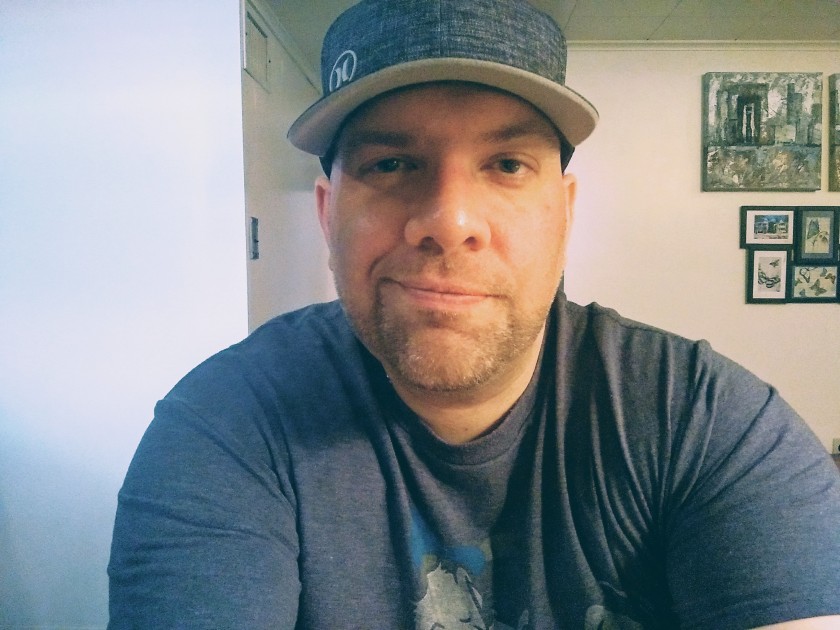
To celebrate Pride Month in June, we wanted to highlight the unique experiences of the members of our chronic illness community who are also members of the LGBTQIA+ community. Today’s email is by Stephen Fratello, a Mighty contributor who lives with chronic conditions including mast cell activation syndrome, anxiety and depression. 

IMG_20180619_105923541_2

Hi everyone,

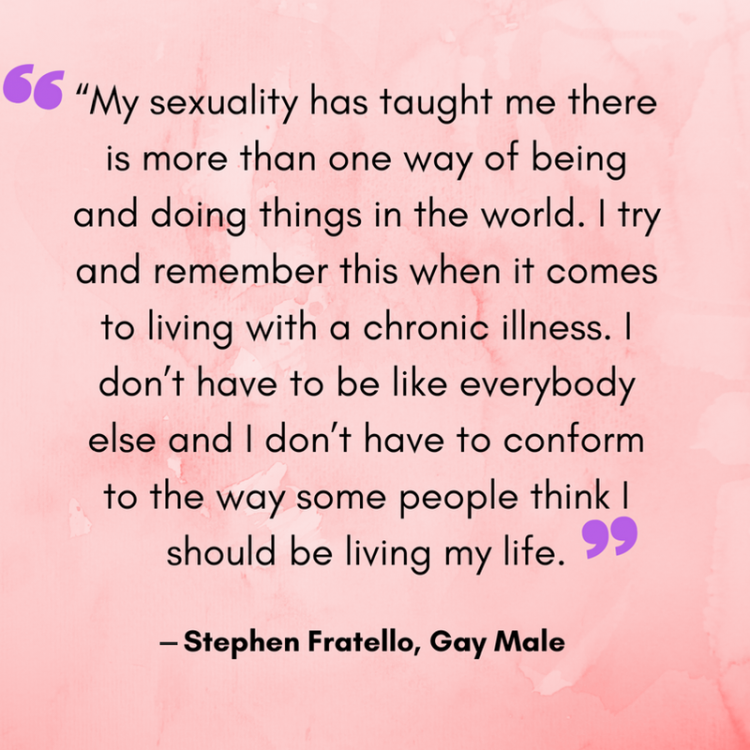
It can be tough living with a chronic illness, and one decision we all face is who to “come out” to about our health challenges. I know about coming out because I’m gay. I also live with chronic illnesses.

Sometimes it can feel like I am continually having to decide how to reveal my health challenges and when. I try to determine if the person is a safe person to open up to. It can provoke a lot of anxiety and questions. Things like, “Will I be judged and rejected?” “Can I handle being abandoned for something that is beyond my control?” “Will people understand me?”

While I am long past any insecurities about my sexuality, it is not so simple when it comes to my diagnoses. Having depression and anxiety can carry a lot of stigma. Having a physical illness that is not fully understood in the medical field, as well as in society as a whole, can be really frustrating. It creates a lot of obstacles and it takes a deliberate choice to live authentically and unashamed.

I was inspired by singer Mariah Carey, who came out this past year about her struggle with bipolar II disorder. She once wrote the following in the liner notes of her CD, “Rainbow”:

In a perfect world,
Human beings would co-exist,
Harmoniously, like a rainbow,
A multitude of colors,
Each layer vibrant and clear by itself,
But in unison…
Boundless, breathtaking, celestial…

I just want to reach out and encourage everyone in the LGBT community to share their stories of illness, just as we come together to share our stories about who we are. We are as diverse as the rainbows that fill the sky. We all have a unique story to tell and in doing so, we make others feel less alone and marginalized, while simultaneously finding liberation for ourselves. It’s no wonder the symbol for the LGBTQ community is the rainbow – it’s a beautiful representation of the diversity that exists in the world.

It’s my hope that Mariah’s words come true — that all of us, no matter who we are, or what our challenges may be — might come together and live harmoniously, claiming our place in the world with authenticity, vulnerability and compassion for one another.

Stay Mighty,
Stephen Fratello

Please share your story at http://www.themighty.com.