Why Churches Need To Educate Themselves On Mental Health

stocksnap_kh9f6o9ih9

My Christian faith has always been a big part of my life starting from when I was young. I was sent to Catholic school and was raised in a liberal, but faith-filled family. My faith has always been something I turned to during my dark moments with depression and physical illness.

I remember a time when I had taken a break from “formal church” and felt very isolated and disconnected. I started to seek out connection within faith communities. I thought it would help me feel better, but it did not. It had the opposite effect. I realized that many churches and their pastors are not equipped to deal with things like mental illness.

I approached a pastor from a local church and told him my story and asked if he would be open to letting me start a support group for people with mental illness. Not only did he tell me that he did not believe that I was depressed, he blew me off and shooed me away.

After I regrouped and got over my disappointment, I tried another church. This time I was looked at like I was crazy, as if mental illness wasn’t real or something that belonged in church.  I was given the run around from one person to the next who politely refused to engage in any sort of conversation. It was clearly not a priority to the leadership.

“One more time”, I thought. I figured this time I would blend in. I found another church. I showed up for healing services and liturgies. I even volunteered for a few ministries. At one point, a staff member asked me what I did for work. I said that I was not working and was on disability for anxiety and depression. He then proceeded to say, “Oh, I work with crazy people.” I was stunned. I could not believe what just happened. I was so angry, I went to the pastor and told him what happened. He told me, “Well, we just have to forgive people. The church is imperfect, you know.” I was shocked. I left this church and never went back.

Let me address the pastor’s point. Yes, the church is made up of human beings that are imperfect. Pastors are imperfect people who most likely are doing the best they can and they can’t be all things to all people. This does not excuse wrongdoing and turning a blind eye to injustices going on. This is not an excuse to not deal with issues that present themselves to you or to ignore the people in need right in front of your face. You have taken a vow to help these people. It is your obligation to educate yourself on what your congregation is going through — to address its needs. If you claim to follow Christ, you have to at least try to act like it.

Churches need to comb the pews, get to know the people that attend there, not just the mentally ill, but everyone. What are their needs? Their stories? Are they chronically ill? Can you start a ministry, even a small one, to help these people? If you can’t, at least be understanding, compassionate and listen. Let them know they are heard and welcomed. It’s the Christian thing to do.


The Media Can Be Misleading About Mental Illness Recovery

depressiongethelpblog

Anyone who sees a loved one depressed, anxious or manic, wants them to seek help and get better. It’s understandable. Who wouldn’t?

There are also tons of well-meaning phrases that people in the media throw at you. “You’re not alone.” “Help is out there.” “You don’t have to live like this.” “Reach out.” While all of these statements have truth to them and are more than likely said from a place of good intentions, they may not be so helpful.

Here’s why:

First, when I was diagnosed with depression and anxiety it took me many months to find a decent doctor. A lot of doctors out there do not listen to you, put you in a box and love to over-prescribe pills. In my case, I cannot take most medications as the side effects are too severe for me to handle. The depression is easier to cope with than the side effects. This has left me seeking alternative treatments like acupuncture, meditation and dietary changes. Not every doctor is open to this. You have to do what’s best for you and it may not always be embraced by the medical community.

Second, the same is true for therapists. I was treated awful by one therapist. He said very inappropriate things to me which I will not get into here, but let’s just say that he probably should have lost his license. Aside from that, finding the right therapist takes time. It’s almost like dating. You have to find one that you click with, who understands your journey and is willing to work WITH you.

Third, taking a pill and going to therapy doesn’t always mean that, “poof!”– you are now magically all better. For many of us with mental illness, it is a series of stops and starts. You try one med and it works…then it doesn’t. You find one good doctor and then then he moves. You try a new med and a new doctor and both end up being a bust. You’re back to square one. You research more treatments. You read books. You join support groups. You learn. You get better and then sometimes worse. And then better again.

Fourth, family members and friends don’t always understand your issues and either don’t take the time to because they either don’t care or they just don’t know how to be there for you. So relationships end up being a roller-coaster and are subject to strain.

While all of this may sound really negative, it’s not meant to. It’s meant to combat the myth that we hear so often when we encourage people to seek help for their mental health. That myth being that once you reach out, go to a therapist and state your feelings–then magically, all will be well. While it’s possible to go to one therapist and one doctor and get one pill that will make you feel almost 100 percent better, that is often not the reality for most people. It’s a journey. It’s YOUR individual journey. I can’t say it will be easy. It’s worth taking, though. Seek answers. Be your own advocate and keep going. When you can’t keep going, take a break. Let it all go for a while. Then start again.

Coming Out: Why More Men Need to Come Out as Chronically Ill

cry-1580550_960_720

When I first was diagnosed as having an anxiety disorder and depression, I searched a lot of sites for help and support. There was one thing that was blatantly obvious. I noticed that men were largely absent from the conversation. Even in the support groups that I attended, men were scarce and the ones that did show up did not really participate. It left me wondering…why don’t men speak out more when it comes to their health issues?

Years later I would develop digestive problems and food allergies. I once again combed the internet looking for support and answers. I found great groups and Facebook pages that offered some help, but once again, no men.

I would read article after article – all written by women and feel so relieved and inspired – that I wasn’t alone in this world of doctors, diseases and medical problems. But then I started to think again, “Where are all the men telling their story?” I knew I couldn’t be the only man struggling with mental and physical issues.

I think our society stigmatizes men more. We are supposed to be tough, strong and resilient. I’m not sure men want to talk about their issues because maybe society programs us not to. We are supposed to just power through and not complain and bitch. It’s seen as pathetic.

Nobody likes to admit they have a problem or health issue. It’s not fun, but when it comes to finding answers and seeking help, why are men less likely?

I guess there are many statistics I could site here, but there is more to it than that. I want to encourage men to come out of the so-called, “chronically ill closet.”

I know for me, I have heard all the lame and hurtful remarks people make. “You look fine.” “You’re a tough guy!” “You can’t feel that bad.” “Toughen up and try harder!” “It’s in your head.”

Women hear these remarks all the time, too, but for some reason it’s implicit that men are not supposed to be ill or live with impairments. Or if they do, they should be able to just RISE ABOVE them and carry on like all is well. As a man, I feel frustrated by this – almost discriminated against.

Today, it seems it’s a lot easier to come out as gay than to come out as having an invisible illness. If I tell someone that I am gay, it’s almost no big deal. “Good for you”, they say. “Live your truth!” “It doesn’t matter, as long as you find happiness,” says another.

So, for all my fellow men who are chronically ill out there –I know that what you want people to know is that it doesn’t matter if they understand what it means to have an invisible illness or not. In fact, they probably never will unless it happens to them. What we care about – what’s most important to us, is that we are treated with dignity and respect. Yes, we are men, but firstly we are human beings. We are sick. We need to reach out to those safe people that understand. I am with you. I support you and I encourage you to come out and tell your story. Together we can help support one another and end the stigma.

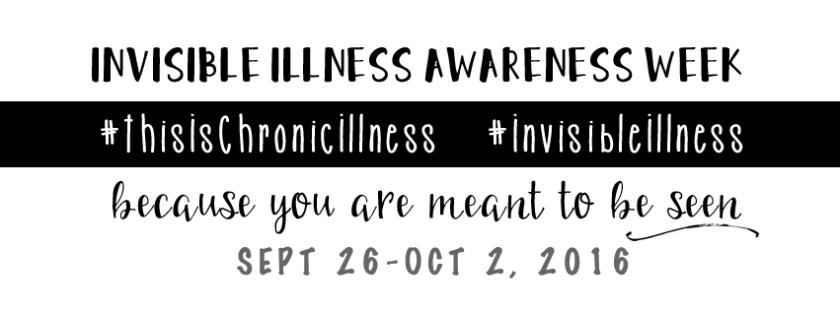
Invisible Illness Awareness Week

invisibleillnessawarenessThis past week was Invisible Illness Awareness Week. Invisible illnesses are illness that impact a person’s life, but cannot be seen physically. They are “invisible” to the naked eye.

One invisible illness is anxiety. Anxiety comes with a whole host of symptoms and emotions. One of the worst feelings is not fear, but regret — the feeling that you just aren’t doing enough to achieve your goals. The sense that life has gotten away from you. That you’re a failure. That you’re lost and can’t get on a solid course.

I relate to feeling lost because my illnesses (anxiety, depression and digestive) have prevented me from doing things people my age (34) are doing and from achieving the goals and dreams I had for myself. I don’t find overly positive ideals and motivational speeches helpful any longer when it comes to combating these demons. I think we need to hold on to hope for a better tomorrow and never give up believing things can improve, but it’s also important to live in the present moment and take each day as it comes and to keep repeating to yourself that you are doing your very best, that this illness really isn’t your fault. Don’t compare yourself to everyone else…you are not everyone else and you aren’t living their life. At the same time other people are not you and are not facing what you have to face.

For me, going to the supermarket is a major ordeal some days. Other people work 2 jobs, go to the supermarket and take care of their kids, while at the same time, managing to achieve their goals. I am not them and they are not me -I keep reminding myself.

This week my goal was to go easy on myself. My dream this week was to just feel a little bit better than I did last week. And maybe help someone feel a bit better too. And guess what? All my dreams and goals came true for this week. Maybe next week I will dream a bigger dream. But that’s next week. Here I am today. And it’s enough.

https://www.facebook.com/InvisibleIllnessWeek/?fref=ts